Best Podcast Host for Video Podcasts (2026)
Last updated: October 2026
This post contains affiliate links, and we may earn a commission if you sign up through them, at no cost to you. See our Affiliate Disclosure. Pricing as of August 2026.
The best video podcast hosting platform depends on what you mean by “video podcast.” If you want a YouTube-first show and clean hosting for the audio everywhere else, get Transistor. If you need real moving-picture video published to Apple Podcasts right now, get Buzzsprout’s Audio + Video plan. One catch up front: most of the industry is still mid-rollout on true video, so what is live today is narrower than the marketing suggests. The video podcast hosting platforms compared below are the ones with a live video plan or a working YouTube path today, so each one is a video podcast hosting service you can sign up for now.
What counts as a video podcast?
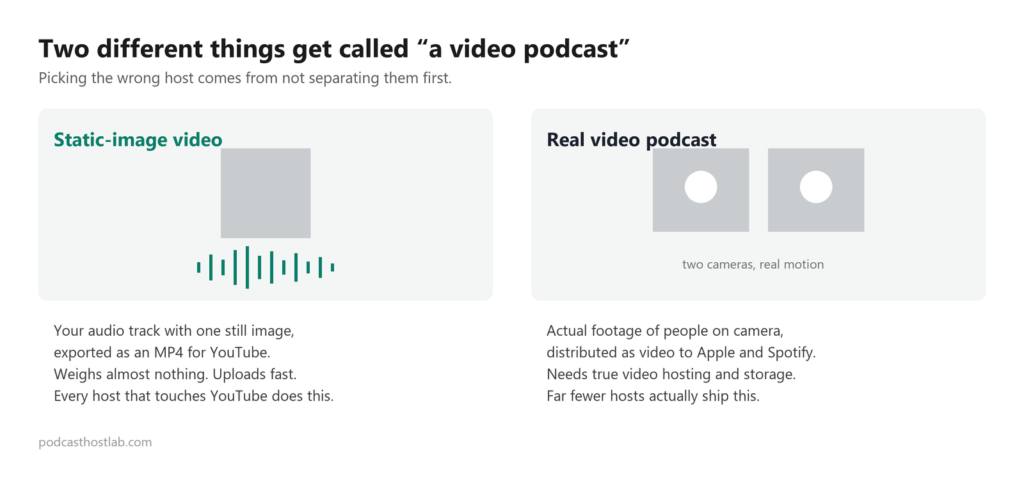
There are two very different things hiding under one phrase, and picking the wrong host comes from not sorting them out first.
The cheap, easy version is a static-image video: your normal audio track with a single cover image or a waveform, exported as an MP4 so it can live on YouTube. It weighs almost nothing, uploads fast, and every host that touches YouTube can do it.
The real version is a moving-picture show: two people on camera, a recorded video file that people actually watch. That needs true video hosting, real storage, and a plan built to distribute the video file itself to Apple Podcasts and Spotify, not just a static frame to YouTube. It costs more and it is where hosts still differ a lot. Sort out which one you are making before you pay for anything, because half the “video” plans only do the first kind well.
What is the best podcast host for video podcasts in 2026?
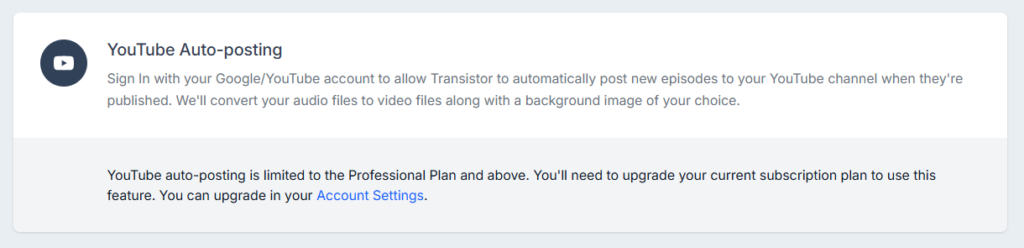
For most people making a video podcast, Transistor is the pick, because a video podcast in 2026 is really a YouTube show with audio distributed everywhere else. Transistor does native YouTube auto-posting on its $49 Professional plan, so every episode you publish pushes to your YouTube channel automatically instead of you re-uploading by hand. That alone saves the step most video podcasters hate. It also hosts unlimited shows on one account, so a network of video shows stays on a single bill.
The honest asterisk: Transistor’s full video hosting, the kind that distributes a real video file to Apple Podcasts and Spotify, is rolling out in beta and runs through a waitlist as of this writing. The YouTube auto-posting is live now. The true moving-picture distribution to Apple is close but not fully shipped to everyone yet. If your show is YouTube-led, that gap does not touch you. If it is Apple-led video, read the Buzzsprout section. And if the point of going video is Spotify money, only five hosts can reach it, which is the subject of the Spotify Partner Program on a third-party host.
Which host publishes real video to Apple Podcasts today?
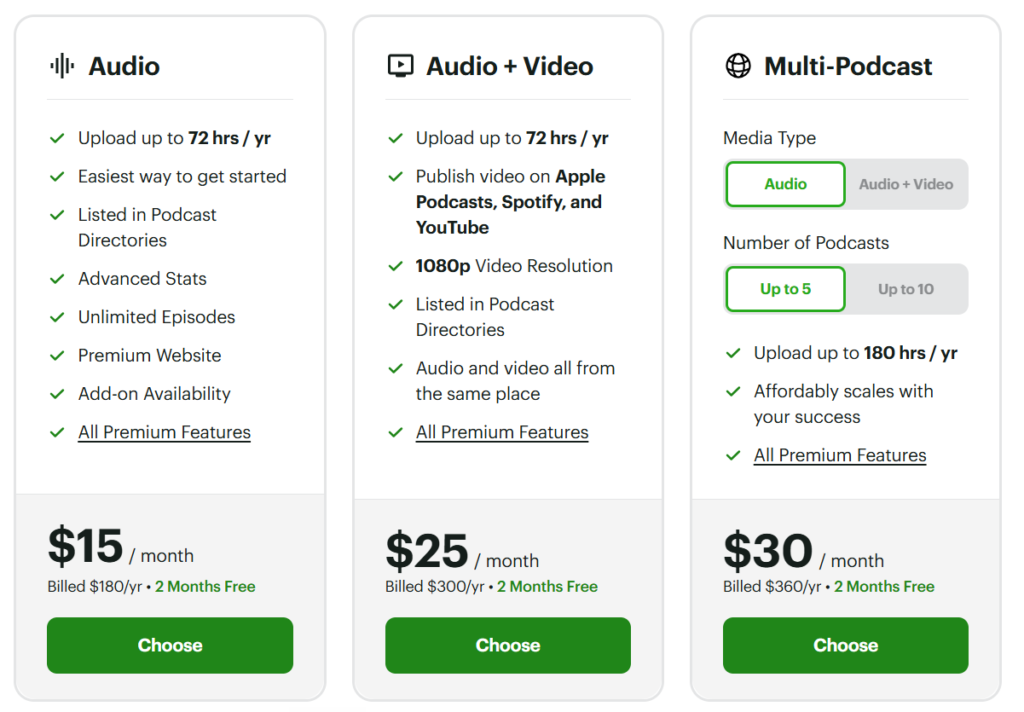
Buzzsprout is the one shipping true video to Apple Podcasts right now, through its Audio + Video plan at $25 a month on annual billing. You upload a real video file, it distributes at 1080p to Apple Podcasts alongside the audio, and a listener can switch between watching and listening inside the same feed. The plan includes 72 hours of uploads a year, which is plenty for a weekly show.
This is no longer a small experiment. Buzzsprout reported on August 19, 2026 that more than 1,000 shows on its platform had published over 11,000 HLS video episodes to Apple Podcasts, and that across 562 established shows it studied, median Apple Podcasts downloads ran 19 percent higher in the 28 days after their first video episode went live. The lift figure is a vendor’s own study and deserves the caution that comes with that, but the volume number tells you the pipeline is worn in and you will not be the one debugging it.
Apple opened video episodes to dynamic ads in the same announcement, and it will charge participating ad networks an impression-based fee for delivering them. That sounds like it should change your monetization plan, and for almost every show reading this it does not, because the ad side went live through four ad networks rather than through hosts. Dynamic ad insertion in plain English covers who it actually reaches.
That makes Buzzsprout the straight answer if “video podcast” means an actual on-camera show that has to be on Apple today, not six months from now. The tradeoff is scope. Buzzsprout’s Audio + Video plan covers a single show, so a multi-show network pays per podcast rather than getting them bundled, and Buzzsprout’s affiliate payout carries a short hold, which does not affect you as a buyer but is worth knowing the host is beginner-first by design. For one polished video show that needs to be everywhere, it is the cleanest live option.
Video podcast hosting platforms compared
| Host | Video plan and price | True video to Apple today | YouTube auto-post | Shows | Best for |
|---|---|---|---|---|---|
| Transistor | Professional, $49/mo | In beta, waitlist rolling out | Yes, live | Unlimited | YouTube-first shows, networks |
| Buzzsprout | Audio + Video, $25/mo annual | Yes, 1080p, live | Via video export | 1 per plan | A single on-camera show, live now |
| Podbean | Unlimited Plus, $29/mo annual ($39 monthly) | Yes, live | Yes | 1 | Cheapest live video hosting |
| Captivate | Personal from $17/mo | Yes, live, $12/mo add-on | No | Unlimited | Audio-led shows adding one video show |
Prices confirmed against each host’s live pricing page, August 2026.
Is Podbean or Captivate worth a look?
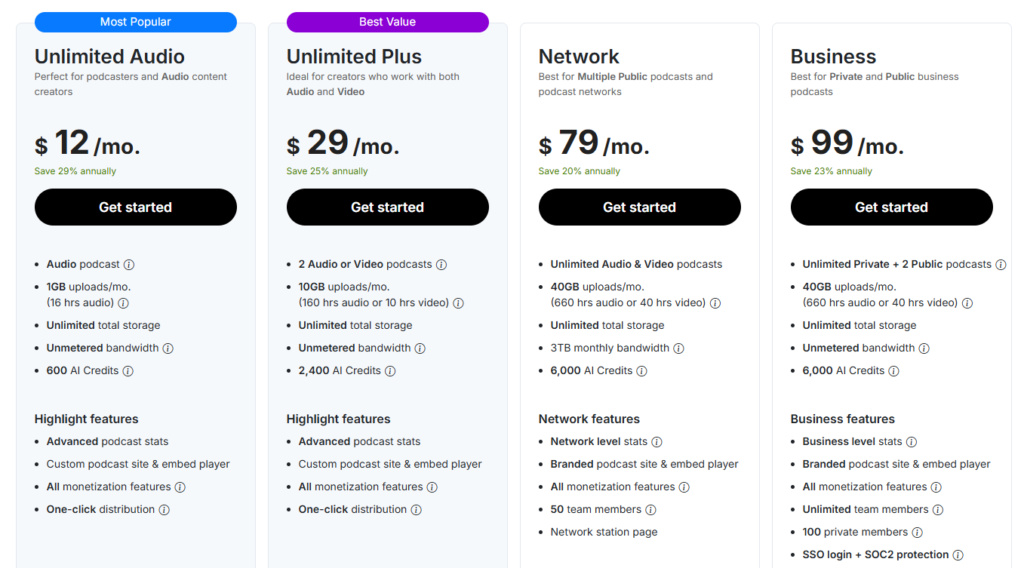
Podbean is the budget answer, and it earns the mention. Its Unlimited Plus plan runs $29 a month on annual billing or $39 month to month, and it includes live video podcast hosting, not just the static-image trick. If cost is the deciding factor and you only run one show, it undercuts almost everyone while still doing real video.
Captivate has shipped, and the wait-and-see note that used to sit here is out of date. Its Apple Podcasts video support went live on April 29, 2026. It works as a $12 a month add-on charged per video podcast on top of a regular plan, which starts at $17 a month, and the first 1,000 HLS downloads each month are included in that fee. Past that you are billed on bandwidth, so an episode that takes off costs more than a flat plan would.
That metering is the real difference between the two live options. Buzzsprout charges $25 a month on annual billing for 72 hours of video a year and does not meter plays, so for a single on-camera show it stays the cheaper and more predictable pick. Captivate earns it when you already run unlimited audio shows there and want to add video to one of them without moving hosts. See Captivate’s plans.
Which video hosts let you monetize on Spotify?
Only five, and none of them are the hosts above. Spotify opened a Distribution API on January 7, 2026 that lets a show publish and monetize video on Spotify from its existing host, and the launch partners were Acast, Audioboom, Libsyn, Omny, and Podigee. Transistor, Buzzsprout, Captivate, and Podbean distribute to Spotify fine. They just cannot get you into the Spotify Partner Program.
This is a real fork in the decision, and it only matters if your show is big enough to qualify. Spotify wants 2,000 consumption hours in the last 30 days and 1,000 audience count before any of it pays, so a new video show should ignore this entirely and pick on the video features above. A show already pulling those numbers on Spotify has a different question to answer, and Libsyn’s Advanced plan at $25 a month is the cheapest documented way in.
Do you need a host to record video, or something else?
You need two different tools, and this is where money gets wasted. A host stores and distributes your finished show. It does not record you.
Riverside is a recording tool, not a host. It captures high-quality local video and audio of you and your guests, then you take that file to a host like Transistor or Buzzsprout to publish it. People conflate the two constantly and end up paying for the wrong thing or expecting Riverside to put their show on Apple Podcasts, which it does not do. Record with a recording tool, host with a host. The same split applies to live-streaming tools like StreamYard and Restream, which broadcast and record but never build the feed. The recording side is a separate decision, and it should not drive which host you pick.
Verdict
For a video podcast in 2026, start with Transistor. Native YouTube auto-posting is live on the $49 Professional plan, it hosts unlimited shows on one bill, and its full video distribution is close behind in beta. Start a free Transistor trial. The one thing to plan around: if you need real video on Apple Podcasts this week rather than next quarter, Transistor’s Apple video is still rolling out, so go with Buzzsprout’s Audio + Video plan instead, which ships 1080p to Apple Podcasts today. Match the host to which kind of video show you are actually making, and you will not overpay for storage you do not use.
The full plan breakdown for the top pick is in the Transistor pricing guide, and if you run more than one show the network angle is covered in the best host for multiple shows.
FAQ
What is the best podcast host for video podcasts? Transistor for a YouTube-first show, on the strength of live native YouTube auto-posting and unlimited shows on the $49 Professional plan. For real video on Apple Podcasts today, Buzzsprout’s Audio + Video plan at $25 a month on annual billing is the live pick.
What is the best video podcast hosting platform? It depends on the kind of video show. Transistor is the best fit for a YouTube-first show, Buzzsprout’s Audio + Video plan is the live pick for real 1080p on Apple Podcasts, and Podbean is the cheapest live video hosting service for a single show.
Can you publish video to Apple Podcasts right now? Yes, through Buzzsprout’s Audio + Video plan, which distributes 1080p video to Apple Podcasts alongside the audio. Transistor’s Apple video distribution is in beta for opted-in customers on Professional or higher, and Captivate’s went live in April 2026 as a $12 a month add-on.
Is a static-image video the same as a real video podcast? No. A static-image video is your audio with one cover image exported for YouTube, which almost any host can produce. A real video podcast is a recorded moving-picture file that needs true video hosting and more storage, which is the harder feature to find live.
Does Riverside host video podcasts? No. Riverside records high-quality video and audio of you and your guests, but it does not host or distribute the finished show. You still need a host like Transistor or Buzzsprout to publish it.