How to Find Podcast Sponsors: See Which Brands Already Buy Ads in Your Niche
Last updated: November 2026
This post contains affiliate links, and we may earn a commission if you sign up through them, at no cost to you. See our Affiliate Disclosure. Podmerse gave Podcast Host Lab free Pro access to test its database for this guide. Podmerse has no affiliate program, so we earn nothing if you sign up there. Pricing as of November 2026.
Find the brands already paying shows like yours, and pitch them first. A company that bought ads on three podcasts in your category last month has the budget, a reason to want your listeners, and someone inside who has already said yes to podcasting. You can dig those brands out of show notes for free, or pull them from a sponsor database like Podmerse in a few minutes.
This is for shows doing roughly 5,000 downloads an episode or more and ready to pitch brands directly. Smaller than that, a host’s ad marketplace usually pays sooner, and our guide to how many downloads you need to get a podcast sponsor lays out each route by size.
Key takeaways
- The strongest podcast sponsor leads are brands already buying ads on shows in your category, because they have a budget and have already said yes to podcast ads.
- Show notes are a free sponsor list, since shows often paste the sponsor’s name, promo code, and offer URL there for anyone to read.
- Podmerse, a podcast sponsorship database that launched on October 28, 2026, says it tracks more than 360,000 brands across about 44,000 podcasts and updates daily, though a search for brands sponsored in the last 30 days came back empty when we tested it on November 6, 2026, and the newest dates we found were from launch day.
- Podmerse’s free plan allows 25 searches for the life of the account, and its Pro plan costs $19 a month, per its pricing page on November 20, 2026.
- Podmerse reads smaller podcasts from their show notes only, so an ad read on air but left out of the notes never makes it into the database.
- In Podmerse’s launch data, 34% of the brand and show pairings it recorded in Q1 2026 showed up on the same show again in Q2 2026, a figure the company itself calls a record rather than an exact count.
Where do you find brands that already sponsor podcasts like yours?
In the show notes of podcasts your size, in your category. That is where hosts paste the sponsor’s name, the promo code, and the offer URL, and it is all public. Nobody has to tell you anything. You just have to read.
Here is the free version, start to finish:
- List 10 to 15 shows in your category that are roughly your size or a little bigger. Skip the chart toppers. Their ad deals usually run through networks and agencies, and a pitch from a 5,000-download show will not land in that inbox.
- Open each show’s last eight to ten episodes in your podcast app and read the notes. Write down every “sponsored by” line, every promo code, and every offer URL.
- For shows with bare notes, play the first two minutes and the middle of two episodes. That is where pre-rolls and mid-rolls sit.
- Put it all in one sheet: brand, show, episode date, and whether the host read it or it sounded like a canned spot.
- Sort by how many different shows each brand turns up on, then by date. The brands on several shows in the last two months go to the top.
It costs an evening. It also only covers the shows you thought to check, which is the gap a database fills. And fix your own notes before you pitch anyone, because the sponsor will read yours too. Our guide to what podcast show notes are for covers what belongs in them.
What does a podcast sponsor database show you?
Who bought ads where, how many times, and how recently, without you playing a single episode. Podmerse is the newest one. It went public on October 28, 2026, and comes from the team behind FeedSpot and MillionPodcasts. Its home and pricing pages say it tracks more than 360,000 brands across about 44,000 podcasts, updated daily, and its press page counts 2 million sponsored episodes drawn from more than 2 million podcasts it monitors.
Per that press page, each entry carries the brand and the podcast it sponsored, how many episodes it ran on that podcast, the date it last appeared, the brand’s industry, and the podcast’s category. In the app on November 6, 2026, the Sponsors tab filtered by last sponsored date, how many podcasts and episodes a brand has sponsored, the brand’s industry and country, and the podcast’s category or name. It had no filter for audience size. Following a brand puts every new show it sponsors into an in-app feed. Email alerts are listed on its home page as coming soon.
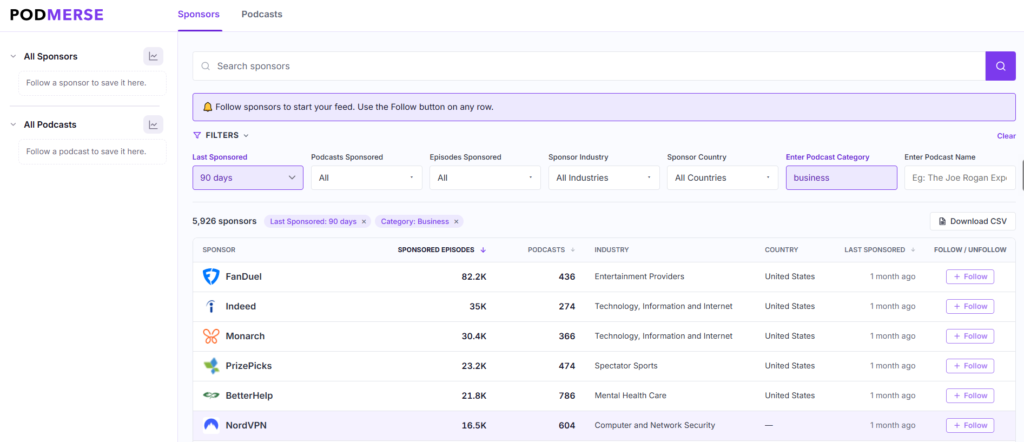
Read two columns together. A brand with 40 sponsored episodes spread over four shows keeps buying the same shows. Somebody there watched the results and bought again. A brand with 40 episodes across 40 shows is running one-episode tests everywhere. Both have money. The first one is far more likely to stay with a show that works for it.
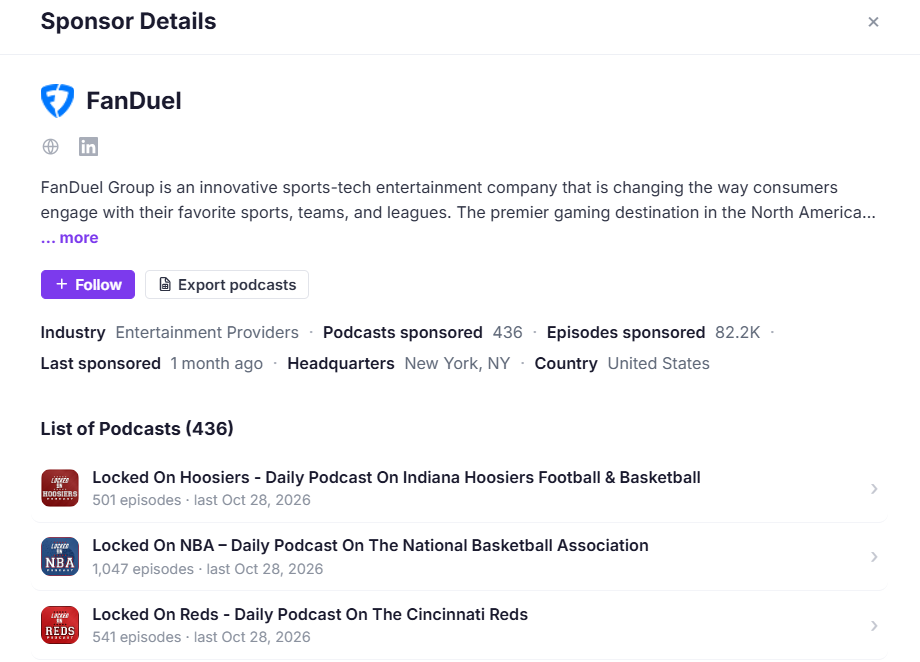
The top of a Business search shows it at full scale. On November 6, FanDuel had 82.2K sponsored episodes across 436 podcasts, close to 190 a show. BetterHelp had 21.8K across 786, under 30 a show. Neither is a lead for a small show, though, and no filter fixes that. The lowest Podcasts Sponsored setting is 1+, a floor rather than a ceiling, so the national advertisers stay on top. For brands that buy shows your size, start from the shows instead: type one you know into the Enter Podcast Name box and see who sponsored it.
What can’t a sponsor database see?
More than the sales page lets on, and the gap is widest on small shows. Podmerse co-founder Anuj Agarwal told us how detection works. It reads the show notes of every active podcast it monitors, and for popular podcasts it also turns the audio into text. Language models then pull out sponsor mentions, filter the noise, sort each sponsor into an industry, and merge name variants into one brand.
On smaller podcasts, Podmerse works from show notes only. So a host-read ad that never made it into the notes does not exist as far as the database knows. And small shows are the very ones you are studying when you look for sponsors of shows like yours. Its own FAQ adds that occasional false positives happen, too.
Freshness is the other gap, at least for now. We tested it on November 6, 2026, nine days after launch. A search limited to brands sponsored in the last 30 days came back empty in every category, and the brands at the top of a 90-day search were all marked as last sponsored one month ago. Open FanDuel, though, and its top three shows, all daily podcasts, each list a last FanDuel episode of October 28, the day Podmerse launched. That is inside the 30 days the filter called empty, and three daily shows stopping on launch day looks more like the data stopped than the ads did. Until that changes, check a show’s newest episodes yourself before you pitch off it.
So treat every count as a floor. A brand that shows up did buy. A brand that is missing might still be buying on shows like yours, just without a credit in the notes. Before you pitch, play one episode where the database says the brand ran and hear the read for yourself. That tells you whether the host read it or it was a canned spot, which changes what you offer. A record tells you a brand is spending. Whether your audience fits is still your call, and the pitch is still yours to write.
How often do podcast sponsors come back?
Less often than you would hope, if Podmerse’s first numbers are anywhere close. Its press page says that of 125,429 brand and show pairings it tracked in Q1 2026, 34% appeared on the same show again in Q2 2026. Two in three did not.
How it counted matters. A pairing counted as returning if the brand turned up on at least one Q2 episode of that show. Shows that ran no ads at all in Q2 were left out, so a show that went quiet is not scored as losing its sponsors. The blind spot from the last section runs through this number too: on small shows, a sponsor that came back with an on-air read but no show-notes credit gets scored as gone. Agarwal told us the 34% “is best read as what we recorded rather than an exact count.” Podmerse does not say anyone outside the company has checked it.
Even if the real figure is higher, a sponsor that leaves after one quarter is the normal case, and you should not read it as a verdict on your show. The second booking gets won during the first one, which is why the pitch below builds in a way for the brand to count what your listeners bought.
Which sponsors should you pitch first?
The ones spending right now on shows your size. Rank your list with four checks:
- An ad in the last 60 days. Six months of silence usually means the budget moved somewhere else.
- Several shows near your size, not only the giants.
- Your category, or the one right next to it.
- More than one episode on at least one show, because that means somebody renewed.
A brand that clears all four is your first email. A brand that only buys on the top 20 shows in your category goes to the bottom, however famous it is.
How do you pitch a sponsor at 5,000 downloads?
Keep it short and build it on what the brand already bought. Find the person first. On LinkedIn, search the brand’s name with “partnerships,” “podcast,” or “growth marketing” and you can often find whoever books shows. Then write something you could read in 20 seconds:
- Open with the shows they already sponsor. It proves you did the homework and puts you in a category they have already said yes to.
- Give one honest number: downloads per episode in the first 30 days, counted the way a podcast download is measured, not a lifetime total.
- Describe the listener in one line, by who they are. The download number already said how many.
- Make one concrete offer, such as three host-read mid-rolls over six weeks, each with its own promo code. Price it off current podcast CPM rates so the number does not look invented.
- End on a small question, then follow up once after a week if you hear nothing.
A made-up example of the whole thing: “I saw your promo codes on two trail-running podcasts this fall. I host a weekly trail-running show that averages 6,200 downloads an episode in its first 30 days, mostly runners training for a first ultra. I’d like to offer three host-read mid-rolls over six weeks, each with its own code, so you can see exactly what my listeners buy. Want me to send the numbers and a sample read?”
That code is the part people skip. It is how a brand counts sales, and a brand that can count sales is the one that books a second quarter.
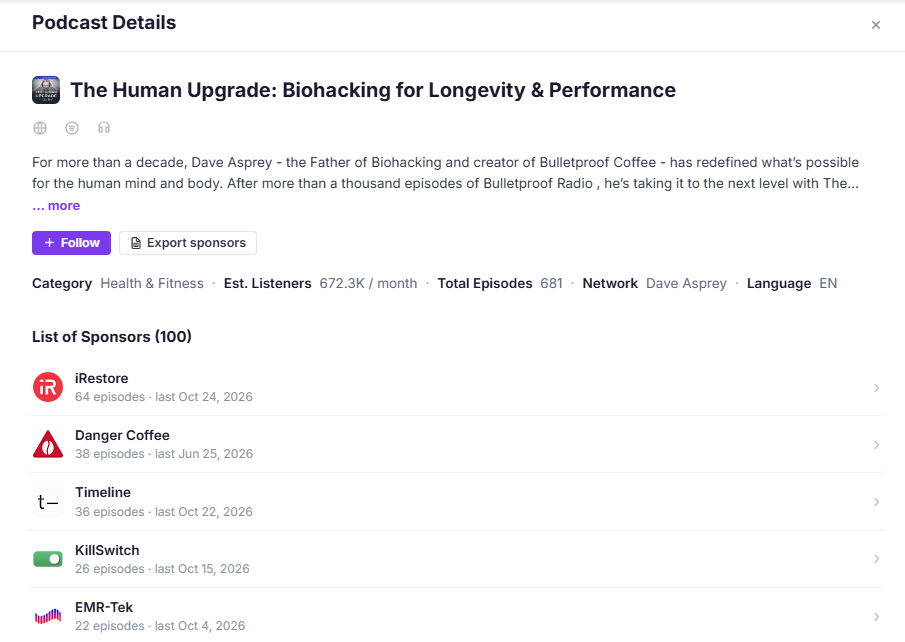
Bigger shows in your lane make good pitch lists, too. Each show page in Podmerse carries an estimated monthly listener count and its sponsors ranked by episodes. On November 6, The Human Upgrade, a Health and Fitness show Podmerse put at 672.3K listeners a month, had iRestore, Danger Coffee, Timeline, KillSwitch, and EMR-Tek as its top five sponsors. Those are niche brands, not the national names from the Business search, and a smaller health show can open its pitch with the codes it heard on that show.
What if you are under 5,000 downloads?
Let a marketplace do the selling while you grow. Hosts with a built-in ad marketplace match small shows with advertisers and drop the ads in for you, so you skip the cold email entirely. Buzzsprout Ads is the gentle start for a first show. The downside is a modest CPM, so early checks are small. Start with Buzzsprout. Acast’s marketplace can pull bigger host-read campaigns as you climb, but its free plan is more on-ramp than home. Look at Acast, or see Acast vs Buzzsprout to pick between them.
The download bar for each of those, and for direct deals, is in our downloads guide, so it is not repeated here. For the money that does not depend on ads at all, see how podcasts make money.
Is Podmerse worth $19 a month?
Not to start. Begin on the free plan. Per Podmerse’s pricing page on November 4, 2026, Free gives you 25 searches for the life of the account and shows only the top results of each, and Pro is $19 a month, or about 25% less billed yearly, with unlimited searches, full results, and unlimited follows. Twenty-five searches is enough for one solid lead list if you plan them before you log in: your category, the shortest last-sponsored window that returns results, and the shows your size from your show-notes list, typed into the podcast name box one at a time. A plain category search opens on FanDuel, Indeed, and BetterHelp, which is not where a small show starts.
Pay for Pro when you are pitching every month and want the follow feed, so a brand that starts buying in your category shows up without you searching for it. The feed is what the $19 buys. You can run a planned search on the free plan.
Three cautions. It reads small shows from show notes only, which undercounts the very sponsors a 5,000-download show is chasing. It is new, public only since October 28, 2026, so there is no track record yet. And on November 4 its own pages still disagreed about whether the free plan exports to CSV, how many results a free search shows, and how search credits work, so read the plan card, not the FAQ, before you pay. Again: Podmerse gave us free Pro access for this test, and we earn nothing if you sign up.
FAQ
Is there a free way to see who sponsors a podcast?
Yes. Read the show notes and listen to the ad slots of shows in your category, then log every brand, promo code, and date in one sheet. It is slower than a database but costs nothing. Podmerse’s free plan adds 25 searches in total, which covers one well-planned lead list.
Do sponsor databases catch every podcast ad?
No. Podmerse transcribes audio only for popular podcasts and reads smaller ones from show notes, so an ad read on air but missing from the notes is not recorded. Use the counts as a floor, and confirm a lead by playing one episode before you pitch.
Should you pitch a brand that just stopped sponsoring a show like yours?
Often, yes. Check whether it is still running ads on other shows. If its last sponsored date is recent somewhere else, it left that one show, not podcasting, and the budget is still live. If it has gone quiet everywhere for months, move it down the list.