How to Start a Podcast With No Audience: A 90-Day Plan
This post contains affiliate links, and we may earn a commission if you sign up through them, at no cost to you. RSS.com, Captivate, and Transistor are among them. See our Affiliate Disclosure. Download figures read on Buzzsprout’s public stats page, and plan prices read on the RSS.com, Captivate, and Transistor pricing pages, on November 18, 2026.
Start anyway, and start smaller than you think you should. Every show begins at zero, and the bar for doing fine is low. In October 2026, half the episodes on Buzzsprout got 27 or fewer downloads in their first seven days. An episode that reaches 28 is in the top half.
So a new show’s first job is small and specific: find 20 people who want it, get an episode past 28 first-week downloads, then push one past 99. Below is how to do that in four phases over 90 days, with the numbers to check along the way.
Key takeaways
- In October 2026, half of all episodes on Buzzsprout got 27 or fewer downloads in their first seven days, so 28 first-week downloads puts a new episode in the top half.
- Buzzsprout’s October 2026 tiers put the top quarter at 99 first-week downloads, the top 10 percent at 425, and the top 1 percent at 4,658, across 111,713 active podcasts.
- A show with no audience finds its first listeners through people who already have one: guests who share their episode, shows that book you as a guest, and trailer swaps with shows your size.
- Weekly is the most common schedule on Buzzsprout, where 20.7 percent of shows published every seven days in October 2026.
- RSS.com’s free plan covers one audio podcast with unlimited episodes and downloads at $0, so a show with no audience doesn’t have to pay while it waits.
How many listeners does a new podcast get?
Fewer than you’d guess, which is good news. Buzzsprout publishes download numbers for every active show it hosts, 111,713 of them in October 2026, counted under the IAB’s 2.2 measurement guidelines. Here’s where an episode lands after its first seven days.
| Where the episode ranks | Downloads in its first 7 days |
|---|---|
| Lower 50 percent | 0 to 27 |
| Top 50 percent | 28 or more |
| Top 25 percent | 99 or more |
| Top 10 percent | 425 or more |
| Top 5 percent | 1,034 or more |
| Top 1 percent | 4,658 or more |
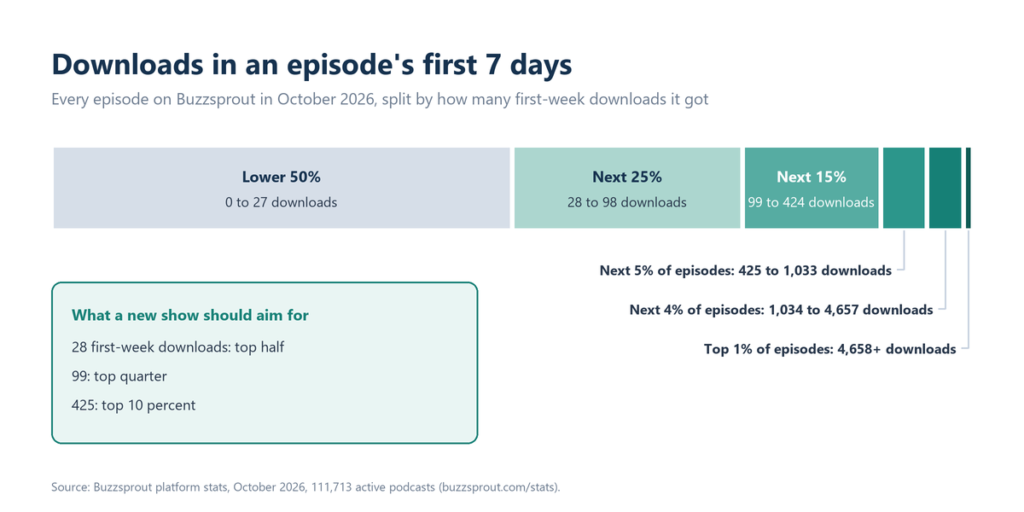
Two things follow. A show getting 15 downloads an episode is normal. And the gap between normal and the top half is about a dozen more downloads. Our guide to good podcast download numbers covers what sponsors look for higher up, and what counts as a podcast download explains how a download gets counted in the first place.
Should you start a podcast with no audience?
Yes, if you can commit to about ten episodes before judging it. That’s our rule of thumb. Starting at zero has one advantage: nobody hears your first rough episodes, so you can fix the sound, the length, and the format while the mistakes are cheap.
The harder question is who it’s for. “People who like movies” is too wide to find. “Parents who want one family movie a week that both kids will sit through” tells you exactly where to look. Before you record, finish this sentence: “A show for ___ about ___, so they can ___.” If you can’t name ten actual people who fit it, narrow it until you can.
What should you do before episode 1?
- Pick a cheap host: a free plan is fine while you find out if the show works. Three options are at the end of this page.
- Record a trailer and three episodes: three gives a new listener something to binge. Apple Podcasts lets you mark a short episode as a trailer, and our guide to making a podcast trailer covers how.
- Submit early: send the feed to Apple Podcasts and Spotify a few days before launch, because a new show is reviewed before it appears. Our guide to submitting to Apple and Spotify walks through both.
- Write down 20 names: people you’ll message one at a time on launch day, each with a link to the one episode you think they’d like most. For a show nobody knows yet, a personal message does more than a post to everyone.
What does a 90-day plan for a new podcast look like?
Four phases, each with one goal you can check. The download goals come from the Buzzsprout tiers above.
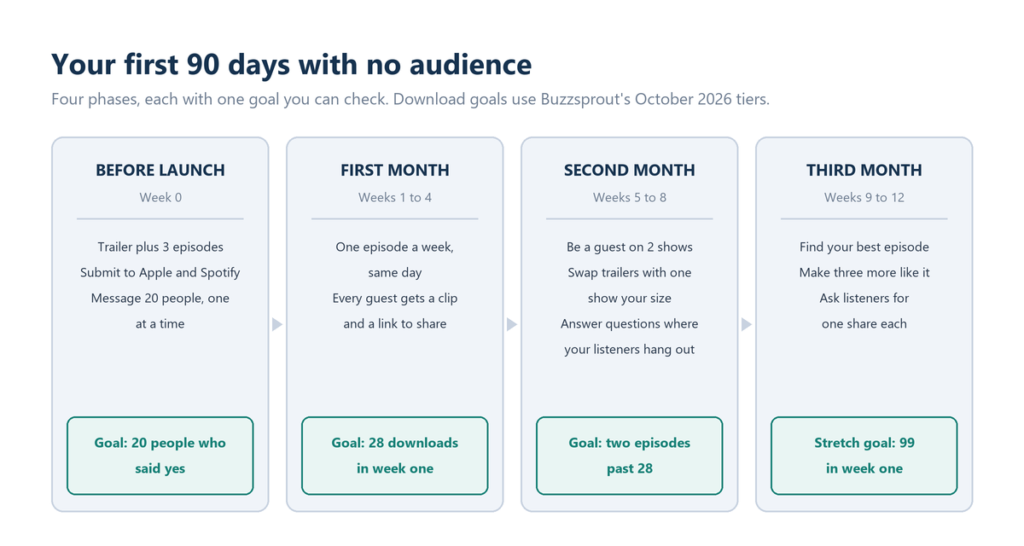
Weeks 1 to 4, publish on a schedule: one episode a week, same day. Weekly is the most common gap on Buzzsprout (20.7 percent of shows in October 2026), and Thursday was the busiest release day. Send every guest a 30-second clip and a direct link the day their episode goes out, so sharing takes them ten seconds. Goal: one episode past 28 first-week downloads.
Weeks 5 to 8, borrow other audiences: pitch yourself as a guest on two shows your listeners already hear. Swap trailers with one show about your size, so you play theirs and they play yours. Answer questions in the forums and groups where your listener spends time, without dropping a link into every reply. Goal: two episodes past 28.
Weeks 9 to 12, double down: sort your episodes by first-week downloads. The top one is telling you what your audience wants, so make three more like it. Then ask listeners for one specific thing, sending the episode to one friend, instead of a rating, a review, and a follow all at once. Stretch goal: one episode past 99, the top quarter on Buzzsprout.
Where do a new podcast’s first listeners come from?
Mostly from people who already have someone’s attention. Early on, these four routes do the work:
- Your own network: one message at a time, to the 20 names on your list.
- Your guests: they have a reason to share an episode they’re in, especially if you hand them the clip.
- Other podcasts: as a guest on theirs, or through a trailer swap.
- Search inside podcast apps: a plain episode title like “How to keep a sourdough starter alive” matches words people type. A clever pun doesn’t.
How do you know if a new podcast is working?
Track one number: each episode’s downloads in its first seven days. It’s the yardstick Buzzsprout uses for the tiers above, so you can see where you rank. Most hosts show downloads by episode and by day, which lets you add up the first seven.
Watch the trend across ten episodes, not any single one. If every episode sits at 10 to 15 after ten tries, change the topic or the titles before you buy a new microphone. Our guide to reading podcast analytics covers the rest of the dashboard.
Which podcast host should you start on with no audience?
A cheap one. With no audience, every month you pay for is a month of waiting, so keep the bill low until the numbers move.
Free while you test: RSS.com Free. It is $0 with unlimited episodes and downloads for one audio podcast, and RSS.com says it has no trial and no expiration. See RSS.com’s free plan. The downside: RSS.com asks for a card before your second episode, though it says the card is not charged.
A talk show you plan to grow: Captivate Personal, $19 a month or $17 a month billed yearly, with unlimited uploads and shows and up to 30,000 downloads a month. Every plan starts with a 30-day free trial. Start a Captivate trial. The downside: you pay from month two whether or not anyone is listening yet.
More than one show: Transistor Starter, $19 a month for unlimited podcasts and 40,000 downloads a month, with a 14-day trial. Try Transistor. The downside: its 14-day trial is half as long as Captivate’s.
Our free podcast hosting comparison lines up the other free plans side by side.
Frequently asked questions
How long does it take a new podcast to get listeners?
Longer than a month, so decide in advance not to judge the show before episode ten. Early on, the useful signal is which episodes beat the others, and that takes a handful of them to see.
Are 10 downloads per episode bad?
No. Half of Buzzsprout’s episodes got 27 or fewer first-week downloads in October 2026, so 10 is inside the normal range for a new show. Treat it as a starting point.
Do you need guests to grow a podcast with no audience?
No, but they help, because a guest has a reason to share. A solo show can grow instead by guesting on other shows and by giving every episode a title that matches what people search for.
Should you build a social media following before you launch?
You don’t have to. Launching to 20 people you messaged yourself counts as a launch, and a few published episodes give you something to post once you do build a following.
Download tiers and publishing data from Buzzsprout’s platform stats page, October 2026 figures, read on November 18, 2026. Plan prices read on the RSS.com, Captivate, and Transistor pricing pages the same day.