Best AI Voice Generator for Podcasters (2026)
Last updated: September 2026
This post contains affiliate links, and we may earn a commission if you sign up through them, at no cost to you. See our Affiliate Disclosure. Pricing as of September 2026.
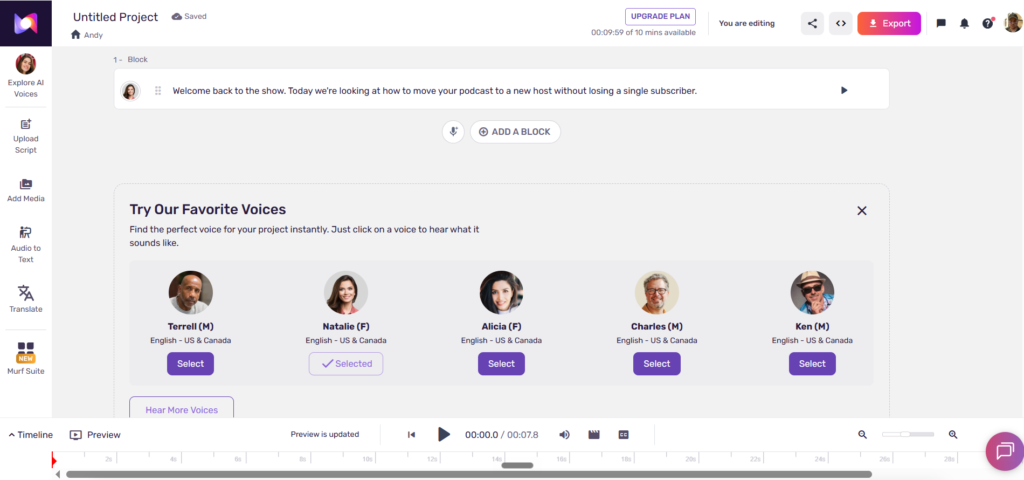
Get Murf if you want a stock voice reading scripted segments, ElevenLabs if you want to clone your own voice for under ten dollars a month, and Descript if you already edit there and just need to patch a flubbed line. One thing first: if your show is two people talking, none of these do anything for you. That is most shows.
What can an AI voice actually do for a podcast?
Five jobs, and only five. It can read a scripted narration segment. It can voice a cold open, an intro, or an outro you rewrite often. It can read an ad you re-cut every month without dragging you back to the mic. It can patch a line you fluffed, so a single stumble does not cost you a re-record. And it can speak your episode in a language you do not.
What it cannot do is carry a conversation. There is no tool here that will interview a guest, react to a joke, or hold the loose back-and-forth that makes a two-host show worth listening to. Synthetic speech falls apart the moment it has to sound unplanned.
So the honest filter is this. If your show is scripted or narrated, an AI voice is a real time-saver. If it is a conversation, buy nothing.
Which AI voice tool should a podcaster pay for?
Three tools cover the five jobs above, and they are not interchangeable. Murf is a voiceover studio built around stock voices. ElevenLabs is the one that clones voices and dubs. Descript is an editor that happens to include a voice clone, which matters if it is already where you cut your episodes.
| Tool | Entry paid plan | Voice included | Clone your own voice? | Best for |
|---|---|---|---|---|
| Murf | Creator, $19/mo billed annually ($228/yr) | 24 hours a year | No, Enterprise add-on only | Scripted narration, cheapest at volume |
| ElevenLabs | Starter, $6/mo | About 30 minutes a month | Yes, on the $6 plan | Cloning your own voice, dubbing |
| Descript | Hobbyist, $16/mo billed annually | 10 media hours a month, 400 AI credits | Yes, on the cheapest paid plan | Patching lines inside an edit you already do |
Prices confirmed against each vendor’s live pricing page on September 21, 2026.
How much voice do you actually get for the money?
This is where the comparison gets slippery, because the three vendors count in different units. Murf sells you hours per year. ElevenLabs sells you credits per month and publishes a rough minute equivalent. Descript sells you media hours and AI credits, which are not the same thing as generated speech.
Normalize the two that compete directly and the gap is smaller than the sticker prices suggest. Murf’s Creator plan is $228 for the year and includes 24 hours of voice generation, which works out to 1,440 minutes, or about 16 cents a minute. ElevenLabs Creator is $22 a month, so $264 a year, for roughly 121 minutes a month, which is about 1,452 minutes a year, or roughly 18 cents a minute. Those are within two cents of each other.
The corroboration is nice. ElevenLabs publishes its own extra-minute rate on that plan at about 18 cents, which is what the division gives you.
Where they genuinely part company is the floor. ElevenLabs Starter is $6 a month for about 30 minutes, so you can be up and running for $72 a year. Murf has no equivalent cheap tier, and its free plan gives you 10 minutes with no commercial rights and no downloads, which makes it a demo rather than a trial.
Can you clone your own voice, and do you have to tell anyone?
You can, on two of the three, and this is the single biggest thing the pricing tables hide. ElevenLabs puts Instant Voice Cloning on the $6 Starter plan and Professional Voice Cloning on Creator at $22. Descript includes custom voice clones on Hobbyist, its cheapest paid tier at $16 a month billed annually. Murf is the odd one out. Its custom voice clones are an Enterprise add-on, so on a normal Murf plan you are choosing from stock voices, not your own.
On disclosure, the rule is narrower than most people assume. YouTube requires you to flag content that makes a real person appear to say something they did not say, and it names cloning your own voice for voiceovers or dubs as exempt from that requirement. Using generative AI on a script, title, or thumbnail is exempt too.
Read that carefully before you relax. Cloning yourself is fine. Cloning your co-host, a guest, or anyone else and putting words in their mouth is the case the policy exists for, and no plan tier makes that acceptable. This matters most if you push episodes to video, so it is worth reading alongside the hosts that auto-distribute to YouTube.
What about dubbing your show into another language?
All three do it, and all three price it differently enough that the answer depends on how often you plan to run it.
Murf sells dubbing as usage rather than a plan. It charges 2 credits per minute per language, with a $5 minimum purchase, so a 40-minute episode into one language is 80 credits and you top up as you go. That suits an occasional translation. ElevenLabs bundles Dubbing Studio into the $6 Starter plan and supports more than 90 languages, which makes it the cheapest way to try the idea at all. Descript locks translation and dubbing to its Business tier at $50 a month billed annually, covering 30-plus languages, which is a lot of money if dubbing is the only reason you are there.
The catch nobody advertises: a dubbed episode needs a home. It is a separate feed, or at minimum a separate episode, and that is a hosting decision rather than a voice-tool decision. Sort out which host you are on before you spend anything here.
Where does AI voice still sound wrong?
Emphasis. Every one of these tools reads a sentence competently and stresses the wrong word in it about once a paragraph. You fix that by hand, marking emphasis and re-rendering, and on Murf the emphasis control is a Business-tier feature at $66 a month, not something the $19 plan gives you.
Length is the other tell. A 20-second read is indistinguishable from a person. Three minutes of continuous synthetic narration starts to feel airless, because the pacing never drifts the way a human’s does. Break long reads into chunks and vary them, or accept that listeners will notice.
Then there is the part no feature list covers. Some audiences hate it. If your show trades on being a real person in a room, a synthetic intro can read as cheap, and no amount of audio quality fixes that perception. Test it on a few listeners before you rebuild your cold open around it.
Verdict
Buy Murf if the job is scripted narration in a stock voice and you expect to generate a lot of it, because at roughly 16 cents a minute it is the cheapest per minute of the three. Its downside is real, though. There is no voice cloning outside Enterprise, and emphasis control costs $66 a month. See Murf’s plans.
Buy ElevenLabs if you want your own voice, or you want to dub, and you want to spend $6 finding out whether any of this fits your workflow. The quotas are small and the overage adds up fast on a long show, so watch the meter. Try ElevenLabs.
Buy nothing extra if you already pay for Descript, because the voice clone is sitting on the plan you have. Check your Descript tier before you add a fourth subscription. And if your show is a conversation between people, the honest recommendation is to skip all of it and put the money toward better audio on the voices you already record.
FAQ
Can an AI voice host my whole podcast?
Technically yes, and it will sound like it. Synthetic speech handles scripted copy well and unscripted conversation badly, so a fully AI-voiced show works only for formats that were already read from a page, such as news briefs, audio versions of articles, or narrated fiction. For anything built on interviews or banter, the tooling is not the limitation. The format is. A listener tunes into a conversation for the parts that were not planned, and there is nothing in a text-to-speech engine that generates those.
Do I have to tell listeners I used an AI voice?
On YouTube, only in specific cases. Its altered-content policy targets material that makes a real person appear to say something they did not, and it explicitly exempts cloning your own voice for voiceovers and dubs, along with using AI on scripts, titles, and thumbnails. So an AI-read intro in a stock voice, or a clone of your own voice, does not trigger the disclosure requirement. Cloning someone else’s voice does. Beyond the policy question, plenty of shows disclose anyway because their audience would feel misled otherwise, which is a judgment call about your listeners rather than a rule.
Which AI voice tool is cheapest for a podcaster?
ElevenLabs Starter at $6 a month is the cheapest way in, and it includes commercial rights, instant voice cloning, and Dubbing Studio. It gives you only about 30 minutes of generated audio a month, so it is a starting point rather than a production plan. If you need volume, Murf’s Creator plan at $19 a month billed annually works out cheaper per minute, roughly 16 cents against 18, because it includes 24 hours of generation across the year. Murf’s free tier is not a real option, since it withholds commercial rights and downloads.
Can I use an AI voice to read my sponsor spots?
You can, and it is one of the better uses, because ad copy changes and re-recording it every month is the tedious part. Two cautions. Check the sponsor’s contract first, since some ad deals specify a host-read spot, and a synthetic read in your own cloned voice is a gray area you want settled in writing. Second, if you run dynamic ad insertion, the ads served into your back catalog are supplied by the advertiser or marketplace, so an AI voice only helps on the spots you produce yourself.