Buzzsprout vs Podbean: Is the Cheaper Host Worth It?
Last updated: September 2026
This post contains affiliate links, and we may earn a commission if you sign up through them, at no cost to you. See our Affiliate Disclosure. Pricing as of August 2026.
Get Buzzsprout if you want the smoother, better-supported host and do not mind paying for it. Choose Podbean if you need cheaper unlimited storage with no upload-hour meter, or a private business podcast with SSO. For most people starting or running a normal show, Buzzsprout is the stronger default, and the full eight-factor framework behind calls like this one is in how to choose a podcast host.
Podbean is the cheaper option on paper, and it packs in features Buzzsprout does not have. But cheaper is not the same as better, and the gap in day-to-day polish and support is real. If price is the only thing driving your decision, cheapest podcast hosting ranks the whole sub-$15 field including both of these. Here is where each one earns the money.
Buzzsprout vs Podbean at a glance
| Buzzsprout | Podbean | |
|---|---|---|
| Entry paid price | $18/mo, or $15 billed annually (6 upload hours/mo) | $17/mo, or $12 billed annually (Unlimited Audio) |
| Free plan | 2 upload hours/mo, episodes deleted after 90 days | Free account to sign up, limits not published |
| Billing model | Monthly upload hours | Flat unlimited, no upload-hour cap |
| Storage | Unlimited on paid plans, hosted permanently | Unlimited total storage on all paid plans |
| Downloads/bandwidth | Unmetered | Unmetered |
| Livestreaming | No, never offered | No, Podbean shut its livestream service down in June 2026 |
| Video podcasts | Yes, on the Audio + Video plan | Yes, on Unlimited Plus and up |
| Monetization | Listener Support, Premium subscriptions, Buzzsprout Ads | Patron program, dynamic ads, premium content |
| Private/internal podcasting | Limited | Yes, Business plan with SSO and SOC2 |
| Analytics | IAB-certified | Advanced stats, IAB-certified |
| Support and UX | Strong reputation, fast human support | Functional, more cluttered |
The headline reads simple. Podbean gives you more for less on raw features. Buzzsprout gives you a cleaner ride and better help when something breaks.
Where Buzzsprout wins
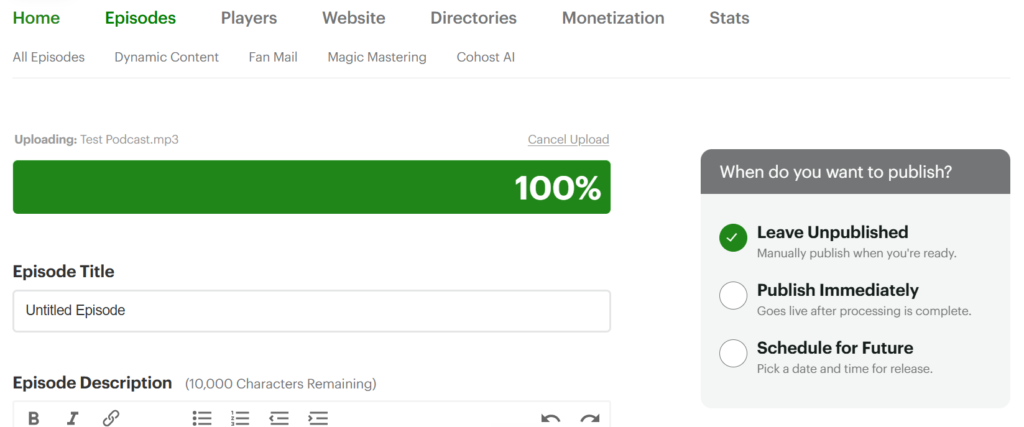
Buzzsprout wins on the stuff you feel every single week: the interface and the support. Uploading an episode, writing show notes, and pushing to Apple Podcasts is faster and less fiddly than it is on Podbean, and the dashboard does not make you hunt. That matters more than a spec sheet once you are actually publishing.
Support is the other half. Buzzsprout has a long reputation for responsive, human help and genuinely useful guides, which is worth a lot when you are new and your feed will not validate. The brand is trusted for a reason. You are paying more, and part of what you buy is not needing to fight the tool.
Where Podbean wins
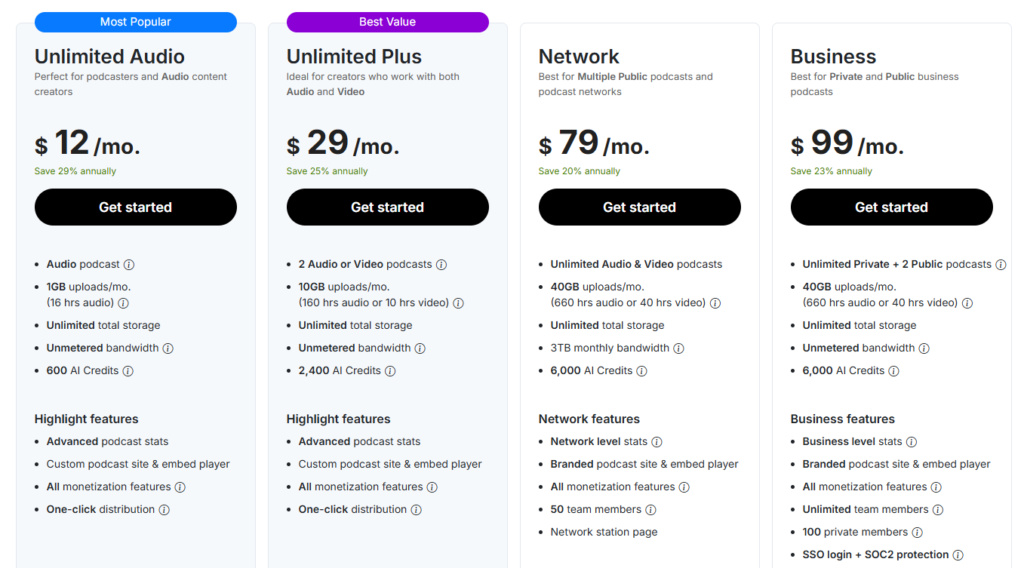
Podbean is not just the cheap pick, and it is fair to say so. Its Unlimited Audio plan runs $12 a month billed annually, a few dollars under Buzzsprout, and hands you unlimited total storage with no upload-hour meter, so you never think about a monthly hour cap. For a heavy publisher or a back catalog, that pricing model is genuinely better.
It also does things Buzzsprout flat out does not. Video podcast hosting sits on the Unlimited Plus tier and up. And the Business plan, $99 a month billed annually, is built for private, internal, company podcasts with SSO login and SOC2 protection, unlimited private podcasts, and up to 100 private members. If either of those is your use case, Podbean is the better call, not the compromise.
One thing to weigh before you commit, though. Podbean used to be the livestreaming host, the one feature nobody else bundled, and it killed it. New livestreams stopped on May 18, 2026, and the service closed for good on June 18. Old recordings stayed put in the Media Manager, so nobody lost their archive, but a tool that tens of thousands of shows leaned on is simply gone, and the reason given was a shift of resources toward AI.
It was not a one-off. Podbean also yanked dynamic ad insertion across Europe in March 2026 with no warning at all, blaming privacy regulation. Neither move touches plain audio hosting, which is what most people are buying here. Both tell you something about how willing this company is to prune a feature you planned around.
If you are already on Podbean and that pattern has decided it for you, moving off without losing subscribers is a four-step job, and the full list of alternatives covers where people are landing.
Buzzsprout vs Podbean on price
At the tier most people buy, the gap is smaller than it looks. Buzzsprout’s real entry is $18 a month for 6 upload hours, or $15 if you pay for the year up front, which covers a weekly show of normal length. Podbean’s Unlimited Audio plan is $17 a month, or $12 annually, and never meters your hours. So paying yearly, it is $12 against $15, a few dollars a month. The full Buzzsprout ladder, including what each tier adds, is in Buzzsprout pricing.
So Podbean wins on sticker price, clearly. The catch is that Buzzsprout’s upload-hour model is fine for the vast majority of shows, and you are paying the premium for the smoother tool and the support, not for storage you will never fill. If budget is the only thing that matters, Podbean wins. If the few extra dollars buys you a host you enjoy using, most people should spend it.
Which should you choose?
For a first show or a normal ongoing podcast, get Buzzsprout. The cleaner interface, the fast support, and the trusted track record make it the host I would hand a beginner without a second thought. Start with Buzzsprout here. The honest downside: it is not the cheapest, and it caps you on upload hours per month, so a very high-volume publisher will feel the ceiling.
Choose Podbean if the price gap is decisive, if you publish long or frequent episodes and want nothing metering your upload hours, or if you are running a private or internal business podcast. Those are real, specific wins. The honest downside there: the interface is busier, the support does not have the same reputation, and it has now killed two features in one year, so plan around what it sells today rather than what you hope it adds. On a straight tie between the two, Buzzsprout is the one I recommend.
New to all of this? Start with the best podcast hosts for beginners before you commit.
FAQ
Is Podbean cheaper than Buzzsprout? Yes, though not by much. Podbean’s Unlimited Audio plan is $12 a month billed annually against Buzzsprout’s $15, and it does not meter upload hours. Buzzsprout costs a little more but is smoother to use and better supported.
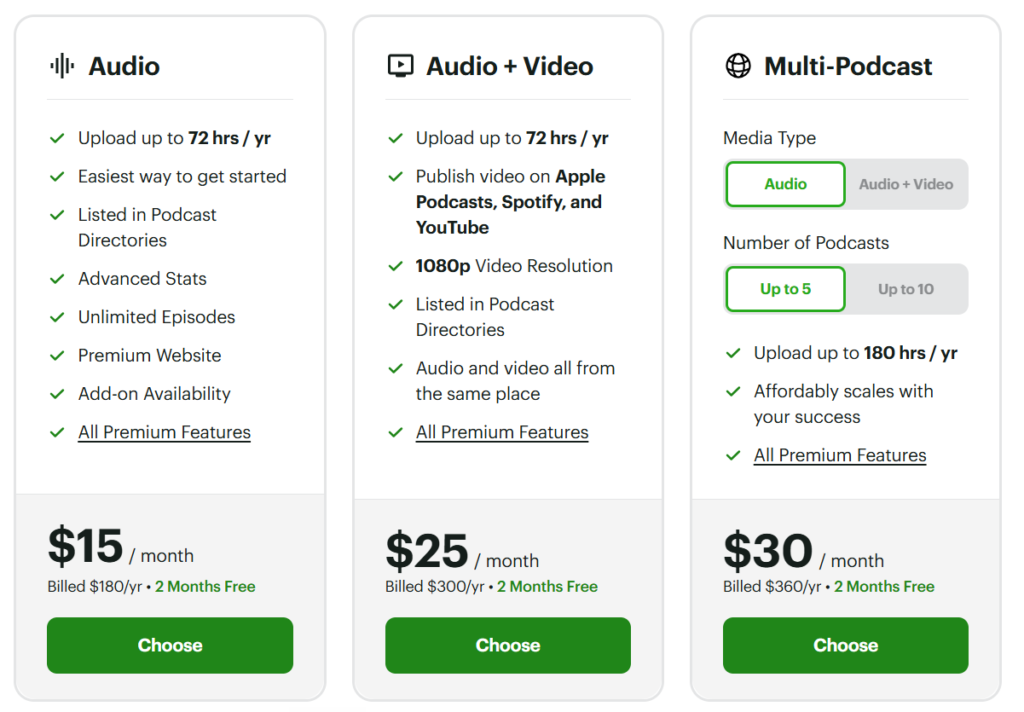
Does Buzzsprout limit how much you can upload? Yes. Paid plans are priced by upload hours: the Audio plan is $18 a month, or $15 annually, for 6 upload hours a month, and the Multi-Podcast plan is $36 for 15 hours across up to ten shows. Adding video is a separate Audio + Video plan at $30. Already-published episodes are hosted permanently on paid plans.
Which host is better for a private or internal podcast? Podbean. Its Business plan is built for private company podcasts with SSO login and SOC2 protection. Buzzsprout is aimed more at public shows.
Can you livestream on Buzzsprout or Podbean? Neither, not anymore. Buzzsprout never offered it. Podbean did, and discontinued it: no new livestreams after May 18, 2026, and the service closed on June 18, 2026. Existing recordings stayed in the Media Manager. If livestreaming is a hard requirement, neither of these two solves it.
Which handles a big back catalog better, Buzzsprout or Podbean? Podbean. Its paid plans give you unlimited total storage with no monthly upload-hour meter, so a large or fast-growing archive never hits a ceiling. Buzzsprout caps the Audio plan at 6 upload hours a month, fine for a normal weekly show but tight for daily or long-form publishing. One more trap: Buzzsprout’s free plan deletes episodes after 90 days, so never build a catalog you want to keep on it.