Host-Read Ads vs Dynamic Ads: Which Pays More?
This post contains affiliate links, and we may earn a commission if you sign up through them, at no cost to you. Captivate is one of them. See our Affiliate Disclosure. Plan prices read on Captivate’s and Transistor’s pricing pages on October 20, 2026. Ad rates and studies are dated where cited.
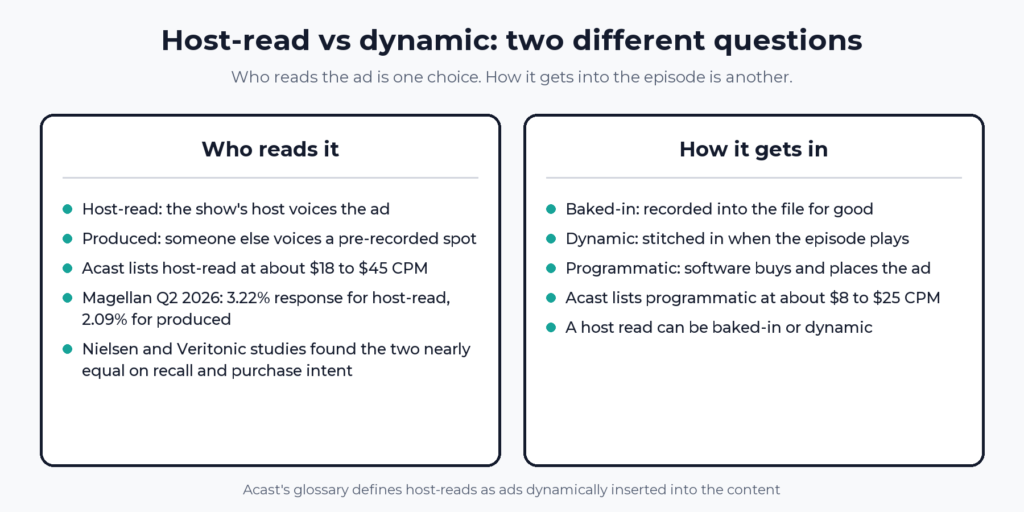
Host-read ads usually pay more per thousand downloads than programmatic ads, but the two terms are not opposites. Host-read says who voices the ad. Dynamic says how it gets into the episode, and a host read can be dynamic. The lower-paying format is the programmatic spot that nobody on the show reads.
Key takeaways
- Acast’s glossary defines host-reads as ads read by the host or producer of a podcast and dynamically inserted into the content, so a host read can also be a dynamic ad.
- Acast’s August 6, 2026 buying guide lists host-read sponsorships at roughly $18 to $45 CPM and programmatic or dynamically inserted inventory at roughly $8 to $25.
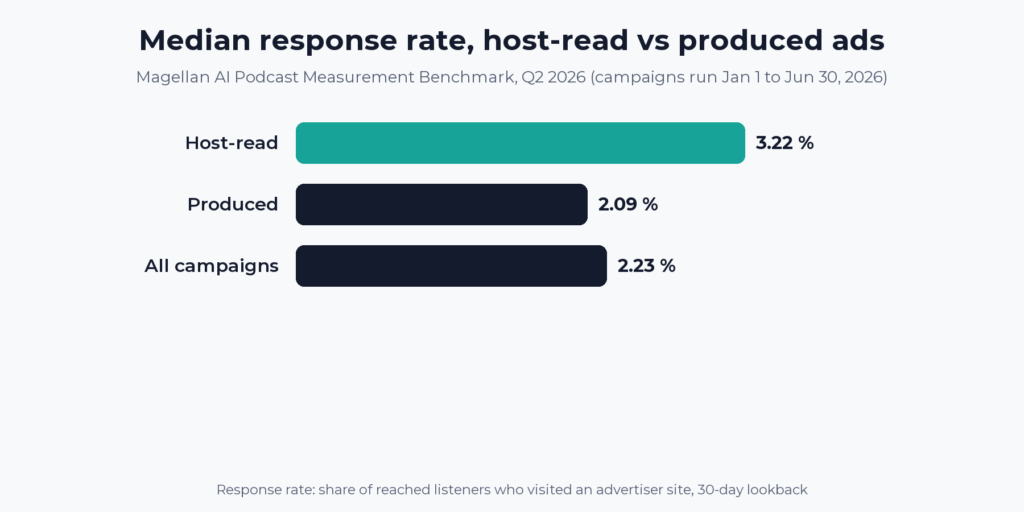
- Magellan AI’s Q2 2026 benchmark found a 3.22 percent median response rate for host-read ads against 2.09 percent for produced ads.
- A Nielsen study commissioned by Spotify and a 2022 NPR and Veritonic study both found host-read and announcer-style ads close on recall and purchase intent.
- IAB reported in October 2023 that dynamic ad insertion made up more than 90 percent of podcast ad revenue.
- Libsyn’s last published average, for September 2024, was a $21.37 CPM on a 60-second spot, drawn from sales data across its ad network.
Are host-read ads and dynamic ads opposites?
No. They answer different questions. Host-read or produced is about who voices the ad. Baked-in or dynamic is about when the ad enters the file. Acast’s glossary defines a host-read as an ad read by the host or producer and dynamically inserted into the content, and Spotify’s advertiser guide describes host-read ads as including a dynamically inserted audio read.
| Format | Who voices it | When it enters the file | Can you swap it later? | What it pays |
|---|---|---|---|---|
| Host-read, baked-in | The host | Recorded into the episode file | No | Acast’s host-read range, roughly $18 to $45 CPM |
| Host-read, dynamic | The host | Stitched in when the episode plays | Yes | The same range. Four media buyers told Digiday in 2017 the price difference from baked-in was negligible |
| Pre-recorded or programmatic, dynamic | Someone else, or software picks the ad | Stitched in when the episode plays | Yes | Acast’s programmatic range, roughly $8 to $25 CPM |
The Digiday report is from December 8, 2017, so use it for the principle and not the prices. It also said third-party spots sold for far less than host reads, which is the gap that matters.
Which pays more per thousand downloads?
Host reads, on every rate card we found. Acast’s buying guide, dated August 6, 2026, lists host-read sponsorships at roughly $18 to $45 CPM and programmatic or dynamically inserted inventory at roughly $8 to $25. CPM is the price per 1,000 downloads or impressions. Acast sells both formats, so read these as a seller’s figures, not what shows were paid.
The ranges move from page to page. Another Acast page lists host-read sponsorships at $25 to $40 CPM and pre-recorded ads at $15 to $30. The only measured average we found is Libsyn’s, drawn from sales data across its ad network: a $21.37 CPM for a 60-second spot in September 2024. That page is marked archived, and we found no newer Libsyn figure.
Applied to one ad slot on a show with 2,000 downloads per episode, the ranges work out as below. This is our arithmetic on Acast’s ranges, before a marketplace or network takes its cut, and it assumes the slot sells.
| Format | CPM range | Income per episode, one slot |
|---|---|---|
| Host-read | $18 to $45 | $36 to $90 |
| Programmatic or dynamic | $8 to $25 | $16 to $50 |
Selling a host read is the hard part. A host-read sponsorship is a sale you make, or a network makes for you, and sponsors that buy host reads usually want scale. Our guide to how many downloads you need to get a podcast sponsor covers the thresholds. Programmatic fills automatically, which is why small shows start there. For the formulas, see podcast CPM and ad rates explained.
Do host-read ads work better?
On Magellan’s numbers, yes. Its Q2 2026 benchmark covers campaigns that ran January 1 through June 30, 2026. Host-read ads posted a 3.22 percent median response rate against 2.09 percent for produced ads, a 54 percent gap. Magellan defines response as the share of reached listeners who visited the advertiser’s site, with a 30-day lookback.
Other studies find a smaller gap. Spotify commissioned a Nielsen survey of 5,999 podcast listeners in late 2020 and reported that host-read and voice-talent ads had nearly the same impact on recall and purchase intent, though host reads built more familiarity and affinity. NPR and Veritonic tested 30-second spots read by a host and by an announcer on 321 NPR listeners and found them within one point of each other on recall, purchase intent, and engagement. Announcer reads scored 6 percent higher on recall for financial brands.
Read the sources before the numbers. Magellan measures site visits across live campaigns. The Nielsen and Veritonic studies measure survey answers to single spots, and Spotify, which sells both formats, paid for one of them. They disagree less than they seem to, because they measure different things. Our read: a host read earns its higher price when the host’s audience trusts them and the product fits. A short, well-made produced spot gets close on recall.
What does dynamic insertion give you that a baked-in read does not?
Control. A baked-in read is recorded into the file and plays for as long as the file does, including after the deal ends and the promo code dies. A dynamic ad is stitched in when the episode plays, so you can run a new campaign across old episodes or pull one. Our dynamic ad insertion explainer covers the mechanics.
That control is why dynamic insertion took over. IAB’s release of October 26, 2023 said dynamic ad insertion represented more than 90 percent of podcast ad revenue, with its share nearly doubled in three years. The release does not split that by host-read and other formats, so it does not mean 90 percent of revenue is non-host-read.
Which should you choose?
Under about 1,000 downloads per episode: programmatic through your host’s marketplace, since host reads rarely sell at that size. Our sponsor thresholds guide puts marketplace ads at about 1,000 downloads. The downside: pay sits at the low end of Acast’s $8 to $25.
A niche show with a sponsor who wants your voice: sell a host read and insert it dynamically, so you can retire it when the deal ends. The downside: you write and record every read.
A show with a big back catalog: dynamic insertion, so old episodes earn too. The downside: a slot that does not sell earns nothing.
To insert dynamic ads on a small budget, Captivate lists dynamic content insertion on every plan, from $17 a month billed yearly. Transistor lists dynamic ads from its Professional plan at $49 a month. Our cheapest podcast host with dynamic ad insertion comparison goes further, and best podcast host for monetization covers the rest.
What are the catches?
- Rate cards are asking prices. The one measured average we found is from September 2024.
- Acast’s ranges disagree with each other. Its August 2026 guide says $18 to $45 for host reads, and another page says $25 to $40.
- The studies disagree. Magellan finds a 54 percent gap, and the Nielsen and Veritonic studies find near parity. Sellers paid for some of them.
- Dynamic does not mean cheaper. The discount belongs to third-party spots, not to dynamic delivery of a host read.
- A host read costs trust when the product does not fit. That cost never shows in a CPM.
FAQ
Are host-read ads better than programmatic ads?
They pay more per thousand and, on Magellan’s Q2 2026 data, drew a higher median response rate, 3.22 percent against 2.09 percent for produced ads. Programmatic fills automatically and starts at a smaller size. Which is better depends on whether you can sell a host read.
Can a host-read ad be dynamic?
Yes. Acast’s glossary defines host-reads as ads read by the host or producer and dynamically inserted into the content. The host records the read once, and the host’s platform places it when the episode plays.
How much do host-read podcast ads pay?
Acast’s August 2026 guide lists roughly $18 to $45 CPM, which is $18 to $45 per 1,000 downloads or impressions of an ad. Libsyn’s last measured average, from September 2024, was $21.37 for a 60-second spot.
Do baked-in ads pay more than dynamic ads?
Not because of the format. Digiday reported in 2017 that four media buyers said the price difference between a baked-in host read and a dynamically inserted one was negligible. The cheaper ads are third-party programmatic spots.
What percent of podcast ad revenue is dynamic?
IAB said in October 2023 that dynamic ad insertion represented more than 90 percent of podcast ad revenue. The release gave no host-read split.