Libsyn vs Blubrry 2026: Which Host Fits Your Show?
This post contains affiliate links, and we may earn a commission if you sign up through them, at no cost to you. Libsyn is one of them. Blubrry is not. See our Affiliate Disclosure. Pricing as of October 2026, read on both hosts’ pricing pages and help centers on October 20.
Choose Libsyn if you want the lower price at every plan size we compared, plus IAB-verified stats from its $12 plan. Choose Blubrry if you would rather count hours than megabytes and want a free WordPress site and AI tools on every plan. Blubrry moved its hosting plans from storage to publishing time in July 2026, so most Libsyn vs Blubrry comparisons still online describe plans new customers can no longer buy.
Key takeaways
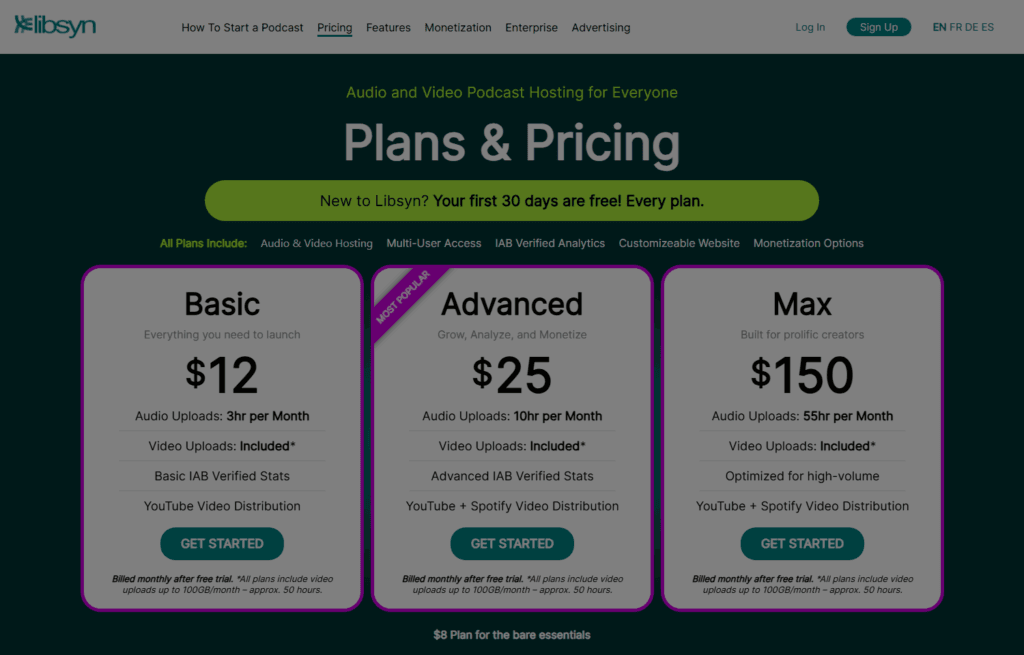
- Libsyn Basic costs $12 a month for 162 MB of new uploads, and Blubrry Standard 3 costs $15 a month for 3 hours of publishing.
- Libsyn meters the megabytes you upload each month, so a lower bitrate stretches a plan, while Blubrry meters hours of content, so bitrate makes no difference.
- Blubrry moved its hosting plans from storage to publishing time in July 2026, and its hosting page says existing customers keep their current plan unless they choose to switch.
- Libsyn lists IAB-verified stats on its $12 Basic plan, while Blubrry’s own stats table lists IAB-certified statistics only with Advanced hosting, which starts at $25 a month.
- Libsyn gives every new account 30 days free with a card on file and bills monthly only, while Blubrry’s annual toggle takes about 10 to 14 percent off on four of its six plans.
- Neither host puts dynamic ad insertion on a cheap plan: Libsyn reserves it for quoted Professional and Enterprise plans, and Blubrry lists dynamic advertising on Pro Unlimited from $100 a month.
How do Libsyn and Blubrry compare at a glance?
They are two of the oldest hosts in podcasting, and they now price in different units. The table uses Libsyn’s plans page, its help center, and Blubrry’s plans page, all read on October 20, 2026.
| Libsyn | Blubrry | |
|---|---|---|
| Price range | $12 Basic up to $150 Max, plus an $8 plan without stats | $7 Standard 1.5 up to $90 Advanced 25, then Pro Unlimited from $100 |
| What the limit measures | Megabytes of new uploads a month, with hours estimated at 128 kbps | Hours of audio and video published a month, at any bitrate |
| Free plan | None | None for hosting. A free stats tier works without hosting |
| Free trial | 30 days on every plan, card required | “Free trial included,” length not published |
| Annual billing | None listed, billed monthly | Standard 3 through Advanced 25, our math 10 to 14 percent off |
| IAB-certified stats | Listed on Basic and up | Listed with Advanced hosting only |
| Website | Customizable website on every plan | Free managed WordPress site on every plan, plus the PowerPress plugin |
| Video | Up to 100 GB a month, about 50 hours, on every plan | Counts against the same publishing hours |
| Dynamic ad insertion | Professional and Enterprise, by quote | Pro Unlimited, from $100 a month |
| Plans per show | One plan for each show | Add up the hours across your shows, see below |
How does each host measure what you upload?
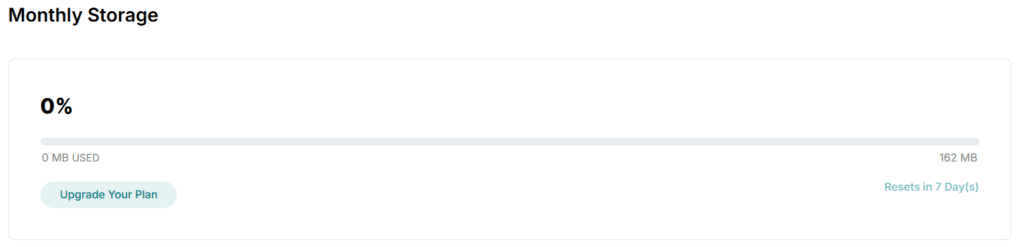
Libsyn counts megabytes, and Blubrry counts time. Libsyn’s Basic plan allows 162 MB of new uploads a month, which it calls about 3 hours at 128 kbps. Blubrry’s pricing page says its plans are based on hours and not megabytes, and its plan guide tells you to multiply episode length by episodes per month.
Libsyn’s storage doc says files you upload this month are labeled Active, flip to Archived at midnight GMT on the first, and then stop counting. Your whole back catalog stays online, and the only limit is how much new content you upload each month.
Take a weekly 40-minute show. At 128 kbps an hour is 57.6 MB, so one episode is 38.4 MB, and four fit in Libsyn Basic with 8 MB to spare. A fifth Thursday makes 192 MB, which is 30 MB over. Export in mono at 96 kbps and an episode is 28.8 MB, so five fit in 144 MB. Our mono vs stereo test has the file sizes for each setting. On Blubrry Standard 3, four episodes are 2 hours 40 minutes and five are 3 hours 20 minutes, so a fifth Thursday goes over no matter how you export.
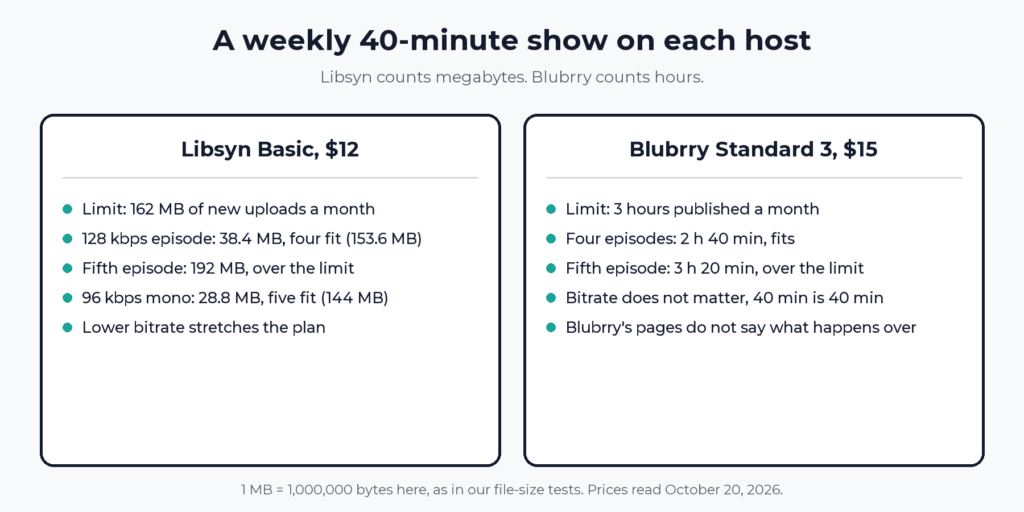
The two hosts differ on what happens when you hit the limit. Libsyn publishes its remedy: early archiving costs 5 cents per MB with a $5 minimum. To fit that fifth 38.4 MB episode you would archive one finished episode early, about $1.92 of archiving, so you pay the $5 minimum. Blubrry’s July 29 announcement says you can upgrade anytime with billing prorated, but none of Blubrry’s pages say what happens when you run out of hours first. Ask before you plan a show that sits near the line.
How do the plans line up by size?
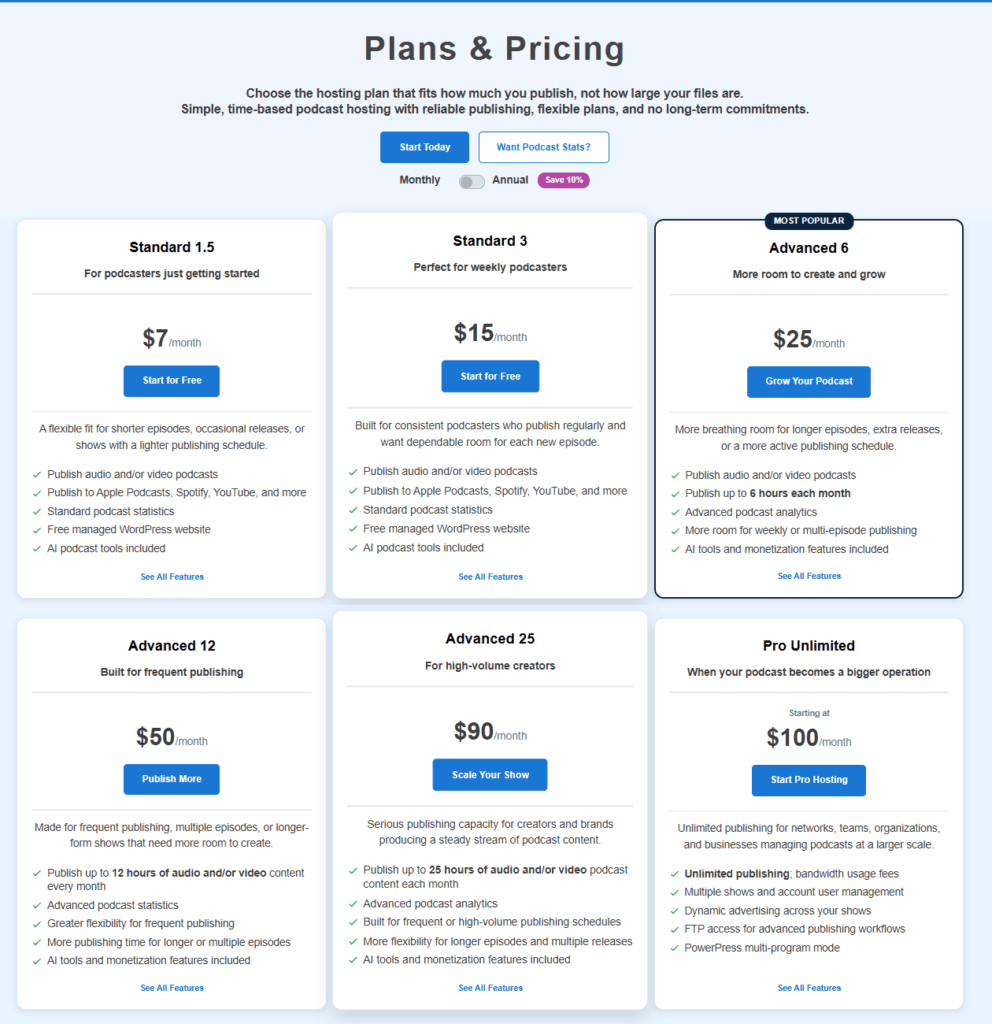
Libsyn is cheaper at every size where the two overlap. The catch is that Libsyn’s hours are its own estimate at 128 kbps, while Blubrry’s hours are real hours. Six of Libsyn’s nine plans only appear in your account after you sign up, as its plan-levels doc explains. Yearly prices on the Blubrry side come from its annual toggle, and the per-month yearly figures are our math.
| About how much a month | Libsyn plan | Blubrry plan, billed monthly | Blubrry, billed yearly |
|---|---|---|---|
| 1.5 hours | No plan this small | Standard 1.5, $7 | Monthly only |
| 3 hours | Basic, $12 for 162 MB | Standard 3, $15 | $155 a year, $12.92 a month |
| 6 hours | Plus, $20 for 324 MB | Advanced 6, $25 | $260 a year, $21.67 a month |
| 10 to 12 hours | Advanced, $25 for 540 MB, or Advanced 650, $35 | Advanced 12, $50 | $540 a year, $45 a month |
| 25 to 27 hours | Advanced 1500, $75 for 1,500 MB | Advanced 25, $90 | $970 a year, $80.83 a month |
| 55 hours | Max, $150 for 3,000 MB | No plan this size, Pro Unlimited starts at $100 | Monthly only |
For the five-Thursday show, Libsyn Basic plus a one-time $5 archive, or Libsyn Plus at $20, undercuts Blubrry’s Advanced 6 at $25. Blubrry closes some of that gap with annual billing, where Advanced 6 works out to $21.67 a month. Libsyn lists no yearly option. Our Libsyn pricing guide walks through all nine plans and the metering rules.
Which host has better stats, and are they IAB certified?
Libsyn puts IAB-verified stats on a cheaper plan. Its plans page lists Basic IAB Verified Stats at $12 and Advanced IAB Verified Stats at $25, and its help center says the $8 plan gets only a dashboard snapshot. Advanced adds geography, destinations, devices, and a stats export.
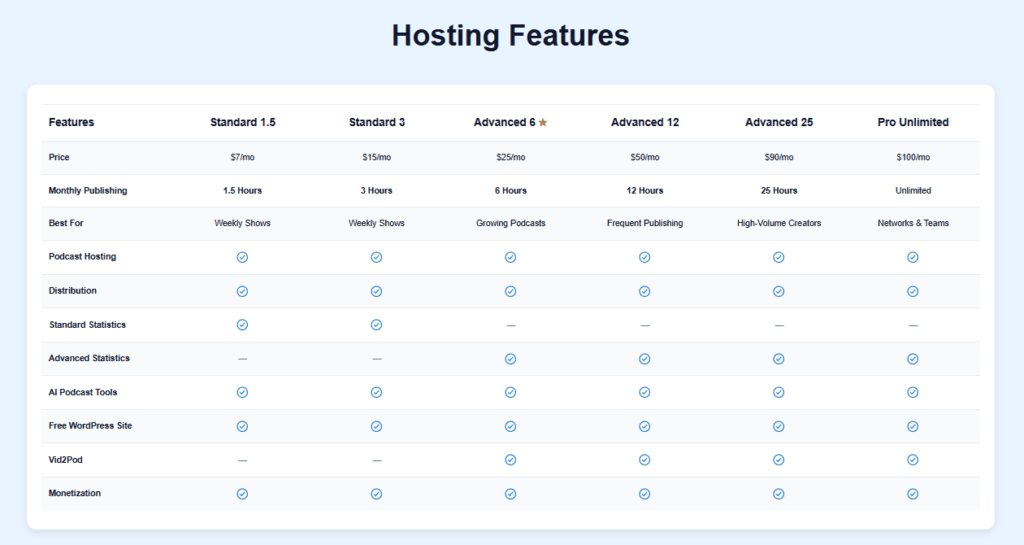
Blubrry’s plans page gives the two Standard plans standard statistics and Advanced 6 and up advanced analytics, including listener retention and partial plays. Its stats comparison table marks IAB-certified statistics as included only with Advanced hosting. Blubrry’s statistics page says its stats are IAB v2.1 certified and require Blubrry hosting, but it does not say which tiers carry the certification. If a sponsor will ask for certified numbers, confirm it with Blubrry before you buy a Standard plan. Blubrry also sells stats on their own, with a free tier and a $5-a-month Standard tier, noting that availability can depend on your host.
What else is different between Libsyn and Blubrry?
- Website and tools: Blubrry puts a free managed WordPress site from Podpage, the free PowerPress plugin, and AI tools for transcripts, summaries, titles, chapters, and clips on every plan, per its hosting page. Libsyn lists a customizable website on every plan, and its plans page does not list comparable AI tools.
- Video: Libsyn lists video uploads up to 100 GB a month, about 50 hours, on every plan, apart from the audio meter. Blubrry’s plan guide says audio, video, and combined content use the same publishing-time model, so a one-hour video episode uses an hour of a 3-hour month. Spotify video publishing starts on Libsyn’s Advanced plan.
- Ads: Libsyn’s FAQ says every plan comes with built-in monetization tools like PodRoll and Automatic Podcast Ads, and its team connects you with brand partners for host-read ads. Dynamic insertion is a Professional or Enterprise feature by quote. Blubrry lists monetization on every plan and dynamic advertising on Pro Unlimited. Our dynamic ad insertion guide compares the cheaper routes.
- Trial and billing: Libsyn’s page says the first 30 days are free on every plan, a card is required, and nothing is charged until the trial ends. Blubrry’s services page says a free trial is included and gives no length. In our checkout test on October 28, 2026, Standard 1.5 came to $7 due that day with no code. Exclusive code for Podcast Host Lab readers: with code PHL, checkout showed a “1 Month Free Trial” and $0 due that day, with the first $7 charge a month later. A card is required, the plan renews automatically after the free month, and checkout showed no end date for the code. We may earn a commission when you use it.
- Support: Libsyn says email or phone support depends on your plan. Blubrry says its contact form is monitored business hours, seven days a week, and you can schedule a call.
- More than one show: Libsyn’s help center describes a payment profile as the plan and billing for one particular show, so each show carries its own plan. Blubrry’s guide says to add the hours across all your shows, which suggests one plan can cover several, but its pricing page lists multiple shows only under Pro Unlimited. Ask Blubrry before you count on it.
What if you already host with one of them?
A Blubrry customer has nothing to do. Blubrry’s hosting page says that if you already host with Blubrry, no action is needed, and your current plan stays the same unless you choose to switch to a time-based plan. Its July announcement had said plans would transition automatically, so read your own billing page before assuming either.
Moving between the two is a normal migration. Blubrry’s FAQ says you can bring an existing podcast over without starting again. Whichever direction you go, keep the old feed alive and redirect it so subscribers follow. How to switch podcast hosts covers the redirect, and how to move off Libsyn covers Libsyn’s side. If Libsyn is the one you are weighing leaving, Libsyn alternatives ranks where people land.
Which should you choose?
A weekly talk show on a budget: Libsyn Basic at $12, exported in mono at 96 kbps so five-episode months still fit. Try Libsyn free for 30 days. The downside: no annual discount, a dashboard with a learning curve, and one plan per show.
A show you want counted in hours, with a website and AI tools included: Blubrry Standard 3 at $15, or Advanced 6 at $25 for advanced stats and a cushion. See Blubrry’s plans. The downside: IAB-certified stats start at Advanced, the rule for going over your hours is not published, and the trial length is not stated.
A video podcast: Libsyn’s separate 100 GB video allowance leaves the audio meter for audio, while Blubrry spends the same hours on video. The downside on Libsyn: Spotify video publishing starts at $25.
A first podcast: neither is the gentle on-ramp. See the best podcast hosts for beginners, and weigh Libsyn against the easiest host in Libsyn vs Buzzsprout.
FAQ
Is Blubrry cheaper than Libsyn?
Not at the same size. Libsyn Basic is $12 for 162 MB and Blubrry Standard 3 is $15 for 3 hours. Libsyn is cheaper at every plan size where the two overlap, though Libsyn’s hours are an estimate. Blubrry’s yearly billing narrows the gap by 10 to 14 percent.
Does Blubrry have a free plan?
Not for hosting. Blubrry’s plans start at $7 a month, its services page says a free trial is included without giving a length, and it sells a free statistics tier that does not require hosting.
Does Libsyn have a free plan?
No. Libsyn gives every new account a free first 30 days on any plan, with a card on file, and then bills monthly. Our Libsyn pricing guide covers the cheapest ways to stay on it.
Does Blubrry still use storage limits?
Not on new plans. Blubrry’s plans are based on hours published each month instead of file storage limits. Its hosting page says existing customers stay on their current plan unless they switch.
Which has better podcast stats, Libsyn or Blubrry?
For sponsors, Libsyn lists IAB-verified stats from its $12 plan, and Blubrry lists IAB-certified statistics with Advanced hosting at $25 and up. Blubrry’s advanced tier adds listener retention and partial plays, and Libsyn’s adds geography, devices, and exports.